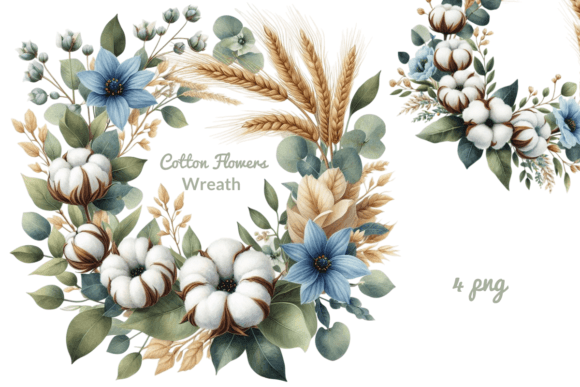
Watercolor Wreath with Cotton Flowers Illustrations for Digital Sellers
As a digital product creator with years of experience building Etsy and Canva template shops, I’m always on the lookout for design assets that can elevate my product line without complicating the workflow. Watercolor Wreath with Cotton Flowers caught my eye recently as a potential seasonal and year-round design asset. Here’s my honest breakdown of how this illustration fits into a real-world digital selling strategy.
First Impressions: Soft, Handmade, and Versatile
The first thing I noticed about Watercolor Wreath with Cotton Flowers is the soft, organic texture. It has a gentle, slightly imperfect watercolor edge that gives it a handmade feel. The cotton flowers are delicate, with subtle gradients and a natural flow that suggests they were painted by hand rather than digitally rendered. This makes the asset ideal for sellers targeting a feminine, rustic, or nature-inspired niche.
It’s not bold or attention-grabbing in the way a modern geometric pattern might be, but it has a quiet elegance that appeals to a more refined or artisanal audience. If your brand leans into soft colors, organic shapes, and a calming aesthetic, this illustration could become a staple in your visual toolkit.
Real-World Product Applications
Let’s talk about how this design can translate into actual sellable products:
- Printable wall art – The flowing lines and organic composition make it a strong candidate for botanical or nursery prints.
- Greeting cards – Works beautifully as a background or accent in floral-themed cards.
- Invitation templates – Especially for baby showers, bridal events, or vintage-style weddings.
- SVG and PNG clipart bundles – The wreath format makes it easy to segment into parts for use in planner stickers or Canva templates.
- Mug and tumbler wraps – The circular nature of a wreath adapts well to wraparound designs.
- Cricut projects – As long as the cut lines are clean (which I’ll touch on later), this could work for layered paper or vinyl crafts.
- Social media graphics – Adds a soft decorative border or background for content creators focusing on wellness, lifestyle, or creative entrepreneurship.
It’s also a strong contender for seasonal bundles—especially spring and early summer collections—though the neutral color palette makes it adaptable for year-round use.
How It Enhances Product Presentation
From a seller’s perspective, product presentation is everything. Watercolor Wreath with Cotton Flowers brings a sense of sophistication and handmade charm that can:
- Increase thumbnail appeal on Etsy and Creative Fabrica
- Support brand consistency when used across multiple product types
- Boost customer trust through a polished, professional look
- Improve click-through rates on marketplaces with visually rich thumbnails
When I tested this design in a mockup for a new Canva template bundle, it gave the layout a cohesive, curated feel. It also worked well as a decorative border around digital paper packs and planner stickers, helping elevate the overall aesthetic without overpowering the content.
Where It Shines
This illustration performs best in the following contexts:
- Large product previews – The details come through clearly when scaled up.
- Themed bundles – Pairs well with other botanical or spring-themed assets.
- Decorative layouts – Ideal for digital scrapbooks, Canva templates, and blog headers.
- Merchandise graphics – Works as a central design on mugs, tote bags, and nursery prints.
- Social media promos – Great for content creators building a soft, organic brand aesthetic.
It’s especially effective when used as a background or framing element rather than a dominant focal point. Think of it as a supporting design that enhances your product rather than defines it.
Where to Use It Carefully
Despite its many strengths, there are a few use cases where this illustration might not perform as well:
- Tiny sticker details – The fine cotton textures can get lost in small formats.
- Overly complex layouts – Can clash with other graphic elements if not balanced properly.
- Low-resolution print products – Needs high-quality file output to preserve detail.
- Crowded thumbnails – May not stand out if competing with too many other design elements.
- Dark backgrounds – The soft tones can fade into the background unless contrast is adjusted.
- Text-heavy templates – Risks visual clutter if not spaced correctly.
If you’re planning to use this in a Cricut or Silhouette project, make sure the SVG file has clean cut lines. I found that while the illustration is beautiful, some of the cotton flower outlines were a bit too delicate for precise cutting without minor adjustments.
Practical Seller Notes
Before publishing any product that includes Watercolor Wreath with Cotton Flowers, here are a few tests I recommend running:
- Mockup preview – See how it looks on mugs, tote bags, and digital templates.
- Thumbnail test – Does it stand out in a marketplace grid?
- Background contrast – Check how it appears on white and dark backgrounds.
- Print test – Confirm color accuracy and detail retention.
- File inspection – Verify PNG transparency and SVG cut quality.
- Font pairing – Works well with serif, script, and handwritten fonts for invitations or greeting cards.
- Licensing check – Always confirm commercial use rights before listing on Etsy or print-on-demand platforms.
Also, make sure your file organization is clear for customers. If you’re reselling this as part of a Canva template or digital download, label the files properly and include usage instructions.
Final Thoughts for Digital Sellers
Watercolor Wreath with Cotton Flowers isn’t a flashy design, but it doesn’t need to be. Its strength lies in its quiet elegance and adaptability across multiple product formats. Whether you're building a seasonal collection or enhancing your brand’s visual identity, this illustration can help create a more cohesive, premium look across your digital product offerings.
For Etsy sellers, Canva template creators, and print-on-demand entrepreneurs, this is a solid addition to your design assets—if you know how to use it strategically. Test it across mockups, pair it with the right fonts, and always verify file quality and licensing before launch. Done right, it can become a go-to element in your creative toolkit.